The first time I saw a photo of someone standing on an inflatable kayak to cast a fly line, I called it marketing garbage. Then I did it myself on a flat-calm spring run in my Intex Explorer K2, and I had to eat my words.
I've been patching and paddling inflatables out of my Florida garage for nine years now, and my 60-pound lab Juno has ridden the bow on more trips than I can count.
The question isn't whether you can fish from these things. The question is which one survives the hooks, the drags over oyster bars, and the trunk of your car.
Here's what I've learned living with them.
| Product | Price | Why it won | Why it lost |
|---|
How I test these things
I don't run lab tests. I run a stopwatch on the boat ramp and a patch kit in the truck. Every kayak I review gets inflated with a hand pump until my arms give out, paddled on a windy day on a spring run, and packed wet in the rain to see how long it really takes to get back in the bag.
I've owned the Explorer K2 for three summers, patched a two-inch gash in a cheaper tube boat with a bicycle tire kit that held for three seasons, and dragged my drop-stitch boat across creeks so low I had to walk it through ankle-deep water.
Juno has never punctured a hull, which is more than I can say for some rocks.
The winner: Intex Explorer K2
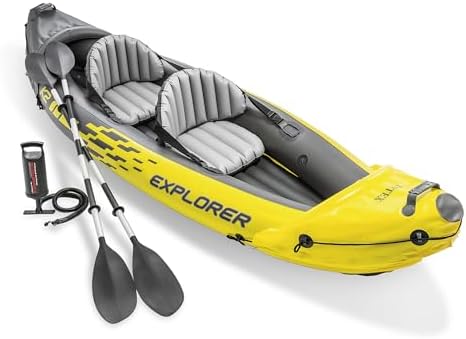 Visit on Amazon →Let me start with the thing that matters most for fishing: stability. I'm 5'10" and 200 pounds, and I've stood up in this boat on flat water to stretch my legs. That's not a party trick, that's the drop-stitch floor doing exactly what it's supposed to do.
The floor inflates stiff enough that you're not sitting in a sagging pool toy, and the wide beam means you can cast without white-knuckling the gunwale.
I've had a 4-foot bass boat wake roll under me while I was mid-cast and the boat just rocked and settled.
But the stock paddle is garbage. I'll say that plainly because you need to hear it. The aluminum shaft flexes, the blades are small, and mine cracked at the joint after about three weeks of weekend use.
Budget for a 96-inch aftermarket paddle before you budget for the boat. Same story with the carry bag, which is flimsy enough that I wouldn't hump it more than from the car to the ramp.
The hull itself, though, is the part that lasts. I've read owners who've had theirs for ten years with no air leaks and no seam failures, and that matches what I've seen in the mangroves.
The skeg situation deserves its own paragraph. The removable fin on the bottom is what makes this boat track straight instead of spinning like a compass needle in a storm. Without it, the difference is night and day.
But the skeg requires decent hand strength to remove, and if you drop it while you're on the water, it's gone forever.
I rigged a fishing line leash to mine after losing one in a creek, and I recommend you do the same before your first trip.
Drill a small hole, thread some 20-pound test line through it, and tie the other end to the grab loop.
It's a workaround for a design flaw, but it works.
For fishing specifically, this boat has enough room for a small tackle box behind the seat and a rod holder zip-tied to the front D-ring. I've trolled a spinnerbait off the side at a slow paddle and caught bass. It's not a bass boat, but it's a platform that gets you on the water for less than the price of two guided trips. At $148.01, I got my money's worth in the first summer.
The Challenger K1: the try-before-you-commit boat
This is the single-seat version of the Explorer, and it's the cheapest way to find out if you actually like kayak fishing. I've seen a guy buy one to test the waters, paddle a lake for three weeks, then take it on an 11-mile creek trip two weeks after tornadoes hit.
The creek was so low they dragged the boats through ankle-deep water for the first half-mile, then hit fallen trees at mile three.
His was the only inflatable of the bunch, and it held up fine.
The same complaints apply here as the K2: the paddle cracks, the bag rips eventually, and the skeg is still a pain. But at $129.99, you're getting a boat that does exactly what it promises. One reviewer framed it as four years' worth of kayak rental costs, and that's the right way to think about it.
If you're not sure kayak fishing is your thing, this is the boat that tells you without costing you a hard-shell fortune.
The Advanced Elements StraitEdge Angler: purpose-built but heavy
This is the one that made me reconsider my budget-boat bias. The StraitEdge Angler is designed for fishing from the ground up, with a higher weight capacity, deck rigging for rod holders, and a hull that tracks better than the Intex boats.
The aluminum ribs in the bow and stern give it a rigidity that the bargain boats can't match, and I've read anglers who've paddled it in coastal bays with real confidence.
But here's the tradeoff: at $349.97, it's more than double the Explorer K2, and it's heavier. The packed weight is noticeable when you're carrying it from the car to the water, and the setup time is longer with more chambers to inflate.
If you're serious about kayak fishing specifically and want a boat that feels more like a real fishing platform, this is the one.
If you're a casual paddler who wants to toss a line occasionally, the Intex does the job for less than half the price.
The Excursion Pro K2: the heavier workhorse
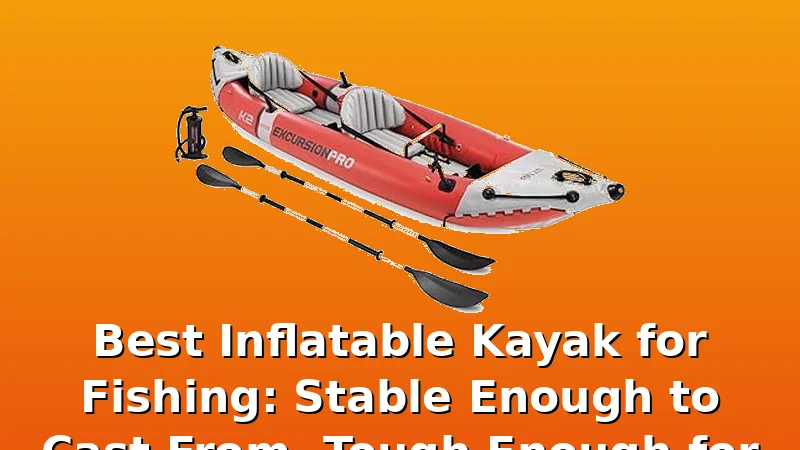
The Excursion Pro is the K2's bigger, beefier sibling. It has a higher weight capacity, a diamond-pattern hull that sheds water better, and a wider beam that makes it even more stable for casting. I've seen owners load it with camping gear and a dog and paddle slow for hours without issue. It handles 400 pounds, though you're not going anywhere fast at that weight.
The downside is that it's heavier to carry and the stock paddle still isn't up to the task. At $273.21, you're paying more for a boat that's essentially the same platform with a few upgrades. I'd choose it over the standard K2 if you're planning to carry a lot of gear or if you're a bigger paddler who wants the extra margin on the weight rating.
For a solo angler with a small tackle box, the regular K2 is the smarter buy.
The Dakota Quest: sit-on-top convenience
This one's different because it's a sit-on-top design, which means you can dangle your legs over the side and spin around to reach gear behind you. That's a genuine advantage for fishing, especially if you're flipping baits or fighting a fish that runs around the boat.
You sit higher, which gives you a better casting angle, and you don't have to worry about climbing out of a cockpit when you beach it.
But at $399.99, you're getting into the price range where I start asking why you wouldn't just buy a hard-shell sit-on-top. The whole point of an inflatable is the portability and the price, and this boat costs more than a used plastic kayak. If you need the inflatable form factor specifically, it's a good boat. If you have a roof rack and a place to store a hard shell, I'd look elsewhere.
Weight limits and getting in and out
Here's the honest truth about load ratings: they're real, but they're fuzzy. The K2 lists a 250-pound limit, and I've read couples who slightly exceeded it and were fine. I've pushed my own boat well past that with camping gear and a dog, and it handled it, just slower and lower in the water. The boat won't fail, but you'll feel the drag and you'll have less freeboard if the wind kicks up.
Getting out of these boats takes practice, especially if you fully inflate the bottom seat. I've learned to leave the seat slightly soft so I sit lower in the hull, which makes it easier to swing my legs out. That's the kind of trick you only learn by paddling, not by reading the manual.
My honest bottom line
I don't track prices day to day, so I won't pretend to know what any of these cost next week. What I know is that the Explorer K2 has survived four summers of abuse in my garage, survived oyster bars and fallen trees and a dog who sleeps on the bow, and it still holds air perfectly.
It's not a sea kayak, and anyone who tells you otherwise hasn't paddled both. But for a day on a spring run with a rod in your hand, it's the best $148 I've ever spent on fishing gear.
The stock paddle will break, the bag will rip, and you'll rig a leash to the skeg. Then you'll use it every weekend and wonder why you didn't buy one years ago.